Taking care of your parquet wood flooring is very important for prolonging its life and improving its appearance and condition. Of course, if correctly and well-maintained, your parquet flooring can live up to a century and still be in tip-top shape, so many generations will enjoy it ahead. In addition, parquet flooring is truly a piece of art with all those beautiful and impressive patterns, colours and grains that add so much character and charm to every space, where it is installed. Because of that, you want your parquet to survive quite a few decades and having a regular and the right cleaning and maintenance routine is the key to achieving that.
Parquet flooring is made out of natural lumber and hardwood materials only and because of that, it is naturally very durable, long-lasting and hard-wearing. The only catch with parquetry is the fact that it needs regular maintenance to keep it looking clean and fresh, but do not be tricked and worry not, because cleaning your parquet is nothing too extensive in terms of time, energy and money, neither a bit different from any other flooring type maintenance.
The general parquet flooring care is nothing that will consume a lot of your time and energy, but it is recommended to practice the simple cleaning regime regularly to keep your floor in tip-top shape. Vacuuming is a good first step and probably a necessary everyday step for your cleaning routine. It is important to be aware of the fact that since the pattern of your parquetry is made out of different-sized boards that are laid in different directions, dirt, dust and grime can easily stick in the fine gaps between the boards and gather in amounts. Do not panic, because vacuuming can reach all those places and spots where dirt is hiding and will loosen the grime to be scrubbed more thoroughly later.
Of course, sweeping your parquet floor will also be recommended now and then, once a week is a good start. Since the accumulated dirt and dust are not only unhygienic and can provoke allergies, but also can scratch the surface of the parquet boards, it is good to include this step in your routine. To achieve the goal you can use a normal brush or a dust-specific dry mop.
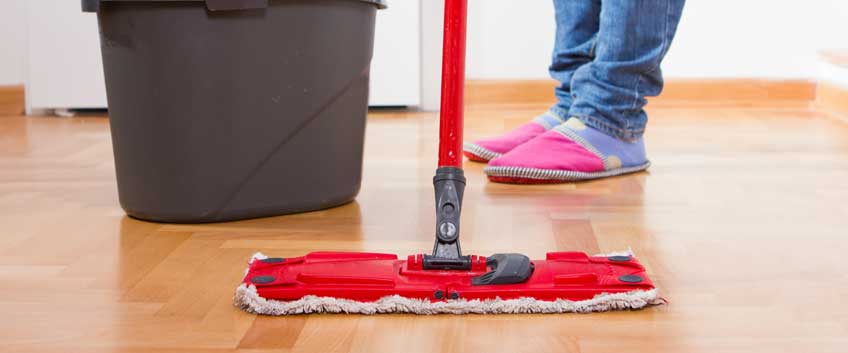
Mopping the floor with water can be a bit of a controversial topic. Of course, the usage of an excessive amount of water is further than recommended, because too much moisture can lead to serious damage to your parquetry, but cleaning with a slightly damp mop is the way to go and get rid of all the dust and dirt that the brush and vacuum machine has missed. Start in one corner of the room and mop in an eight symbol, then work your way through the entire room.
So this is your general cleaning routine for parquet flooring that is recommended at least once every two weeks. If you feel that your floor needs a deeper and more thorough cleaning, then we recommend the usage of cleaning products that are specially designed for wood, do not buy anything multi-tasking or all-in-one products, because they do not come with neutral pH that is the only one recommended for wood and its finish.